Home › Articles
Prebiotics: What They Are, What the Evidence Shows, and How Much You Need
By the Gut Label Check team. Updated October 30, 2026. 6 min read
Disclosure: some pages on this site contain affiliate links. This article is general information, not medical advice.
“Prebiotic” is now printed on fiber powders, sodas, protein bars and capsules. The word has a specific meaning, the evidence is narrower than the marketing suggests, and the right amount is measured in grams, not milligrams.
The short answer
- Prebiotics are food for gut bacteria: mostly fibers such as inulin, FOS and GOS that specific bacteria ferment, with a health benefit.
- What they reliably do: increase bifidobacteria. Inulin also has evidence for more frequent, softer stools, at doses around 12 g a day.
- Where they backfire: in IBS. Trials found no symptom relief, and inulin made gas worse.
- Cheapest per gram: plain inulin powder, about $0.04. A capsule holds a fraction of a gram.
See a doctor rather than trying supplements if you have: blood in your stool, unexplained weight loss, severe or persistent abdominal pain, ongoing diarrhea, or a new change in bowel habits after age 45.
What counts as a prebiotic
In 2017 an expert panel of the International Scientific Association for Probiotics and Prebiotics defined a prebiotic as “a substrate that is selectively utilized by host microorganisms conferring a health benefit.” In plain terms: something specific gut bacteria feed on, which in turn does you some good.
Two parts of that definition matter when you read a label. Selectively means not every fiber qualifies just because bacteria eat it. Health benefit means more bacteria alone isn’t enough; there has to be a benefit to you.
- Probiotics are live microorganisms, such as Lactobacillus or Bifidobacterium strains. See which probiotic strains have evidence.
- Prebiotics are what bacteria eat.
- Synbiotics combine the two in one product.
The main prebiotic fibers
| Fiber | Where it comes from | What to know |
|---|
| Inulin | Chicory root, Jerusalem artichoke, agave | The most studied. Common in fiber powders and “gut” bars. Fermented quickly, so gas is common. |
| FOS (fructooligosaccharides, oligofructose) | Shorter chains of the same fructose units as inulin | Behaves like inulin, ferments even faster. Inulin and FOS together are called inulin-type fructans. |
| GOS (galactooligosaccharides) | Made from lactose; also in beans and lentils | Well studied, used in infant formula and some supplements. |
| XOS, acacia gum, partially hydrolyzed guar gum | Corn cobs and birch, acacia tree sap, guar beans | Sold as prebiotics; fewer human trials than inulin or GOS. Acacia and guar gum ferment more slowly. |
| Wheat dextrin | Wheat starch | Benefiber labels itself a prebiotic fiber supplement. See our fiber comparison. |
What the evidence shows
Gut bacteria
This is the most consistent finding. A 2019 meta-analysis of randomized trials in adults with IBS and other bowel disorders found that prebiotics increased bifidobacteria. More bifidobacteria is generally seen as a good sign, but on its own it isn’t a symptom you can feel.
Constipation
Inulin has the best data. A 2014 meta-analysis found that inulin improved stool frequency and consistency, but not abdominal pain or bloating. In 2015 the European Food Safety Authority accepted a health claim that 12 g a day of native chicory inulin increases stool frequency. That dose is well above what most prebiotic capsules and many powders provide.
Psyllium is still the better-studied fiber for constipation, and it isn’t fermented much, so it causes less gas.
IBS
The same 2019 meta-analysis found that prebiotics did not improve IBS symptoms or quality of life. Inulin-type fructans made flatulence worse. Flatulence improved only with doses of 6 g a day or less and with prebiotics other than inulin and FOS. Inulin, FOS and GOS are all FODMAPs, the fermentable carbohydrates a low-FODMAP diet for IBS cuts back.
Other claims
You will see prebiotics marketed for immunity, weight, mood, skin and blood sugar. Some of these are being studied, but the evidence is early or mixed, and it doesn’t support buying a product for them.
How much you need, and food first
There is no official daily amount for prebiotics. A 1995 estimate put typical intake of inulin and FOS from food at about 1–4 g a day in the US and 3–11 g in Europe, mostly from wheat, onions, bananas, garlic and leeks.
You can raise that with food: chicory root and Jerusalem artichoke are the richest sources of inulin, onions, garlic, leeks and asparagus add more, and beans and lentils bring GOS.
If you use a supplement:
- Look for grams, not milligrams. The trial doses are several grams a day. A capsule holds well under a gram.
- Look for an amount per fiber. Many products list a “prebiotic blend” with one total, so you can’t tell how much of each fiber you get.
- Start with 2–3 g a day and increase over a couple of weeks. Gas, bloating and cramping depend on the dose.
What a gram of prebiotic fiber costs
Price per gram of fiber from each label. Amazon prices on October 22, 2026, sold and shipped by Amazon; Peak BioBoost from its official site, checked October 18, 2026.
| Product | Prebiotic fiber | Price and size | Fiber per serving | Price per gram of fiber | Cost of 7 g a day |
|---|
| NOW Foods Organic Inulin powder | Chicory inulin | $9.00 for 8 oz (227 g), about 57 servings | 4 g per level teaspoon (3.3 g inulin) | $0.04 | $0.28 |
| Benefiber, Unflavored | Wheat dextrin | $13.48 for 8.7 oz, 62 adult servings | 3 g per 2 teaspoons | $0.07 | $0.51 |
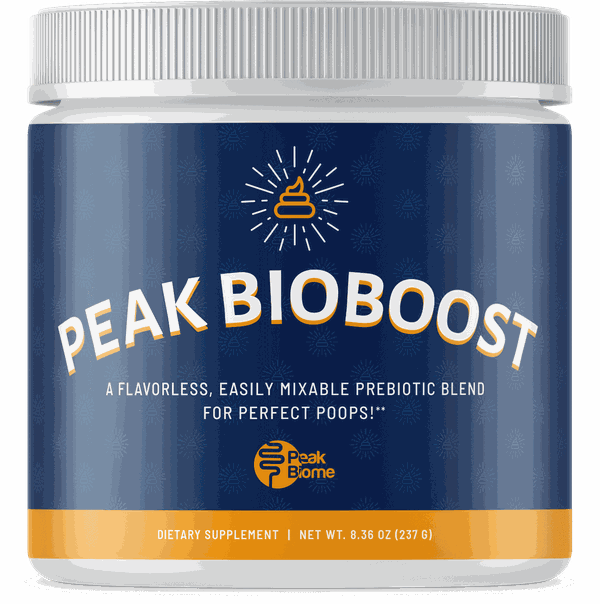
| Peak BioBoost | Inulin, FOS, acacia gum, XOS | $49.95 a jar, or $29.95 each in a 6-jar bundle; 30 scoops | 7 g per scoop | $0.14–$0.24 | $1.00–$1.67 |
How we calculated: NOW inulin 57 × 4 g = 228 g of fiber, $9.00 ÷ 228 = $0.04 per gram. Benefiber 62 × 3 g = 186 g, $13.48 ÷ 186 = $0.07. Peak BioBoost 30 × 7 g = 210 g, $29.95 ÷ 210 = $0.14 and $49.95 ÷ 210 = $0.24; one and three jars add $6.95 shipping.
Plain inulin is the cheapest, but it is a single fiber that ferments quickly. Peak BioBoost mixes four fibers, including slower-fermenting acacia, at four to six times the price per gram; it lists them as one 8 g blend. Read our Peak BioBoost review for the full label and its refund rule.
Who should skip prebiotic supplements
- People with IBS or on a low-FODMAP diet: inulin, FOS and GOS are FODMAPs and often make gas and bloating worse.
- Anyone with SIBO or a sensitive gut should ask their doctor first.
- People who already eat plenty of fiber may gain little from adding more of one kind.
Questions people ask
What is the difference between prebiotics and probiotics?
Probiotics are live microorganisms. Prebiotics are the fibers specific gut bacteria ferment, with a health benefit. A product with both is a synbiotic.
Do prebiotics help with constipation?
Inulin has the best evidence: better stool frequency and consistency in a 2014 meta-analysis, and an EU-approved claim at 12 g a day. Psyllium remains the better-studied option.
Are prebiotics good for IBS?
Usually not. A 2019 meta-analysis found no improvement in IBS symptoms, and inulin-type fructans made flatulence worse.
How much prebiotic fiber should I take?
There is no official amount. The EU claim for chicory inulin uses 12 g a day. Start with 2–3 g and build up slowly.
What foods are high in prebiotics?
Chicory root and Jerusalem artichoke, then onions, garlic, leeks, asparagus, wheat and bananas. Beans and lentils contain GOS.
Prebiotic powder we checked
Peak BioBoost
Inulin, FOS, acacia gum and XOS (8 g blend) plus 40 mg magnesium
Serving1 scoop (about 8 g) a day
Cost per day$1.00–$1.67
Every dose shownPartly
A real fiber dose, 7 g a day, but the advertised star, XOS, is the smallest ingredient.
Check price on the official site
Read the label check
Sources
- Gibson GR et al. Expert consensus document: The International Scientific Association for Probiotics and Prebiotics (ISAPP) consensus statement on the definition and scope of prebiotics. Nat Rev Gastroenterol Hepatol, 2017. doi.org/10.1038/nrgastro.2017.75; summary at isappscience.org
- Wilson B et al. Prebiotics in irritable bowel syndrome and other functional bowel disorders in adults: a systematic review and meta-analysis of randomized controlled trials. Am J Clin Nutr, 2019. PubMed 30949662
- Collado Yurrita L et al. Effectiveness of inulin intake on indicators of chronic constipation: a meta-analysis of controlled randomized clinical trials. Nutrición Hospitalaria, 2014. DOAJ
- EFSA Panel on Dietetic Products, Nutrition and Allergies. Scientific opinion on native chicory inulin and maintenance of normal defecation by increasing stool frequency, 2015. EFSA Journal 2015;13(1):3951
- Van Loo J et al. On the presence of inulin and oligofructose as natural ingredients in the western diet. Crit Rev Food Sci Nutr, 1995. PubMed 8777017
- Product pages, labels and prices on Amazon, checked October 22, 2026: NOW Foods Organic Inulin powder, 8 oz; Benefiber Unflavored, 8.7 oz.
- Peak BioBoost official site: Supplement Facts label, prices and refund policy, checked October 18, 2026. Details in our Peak BioBoost review.