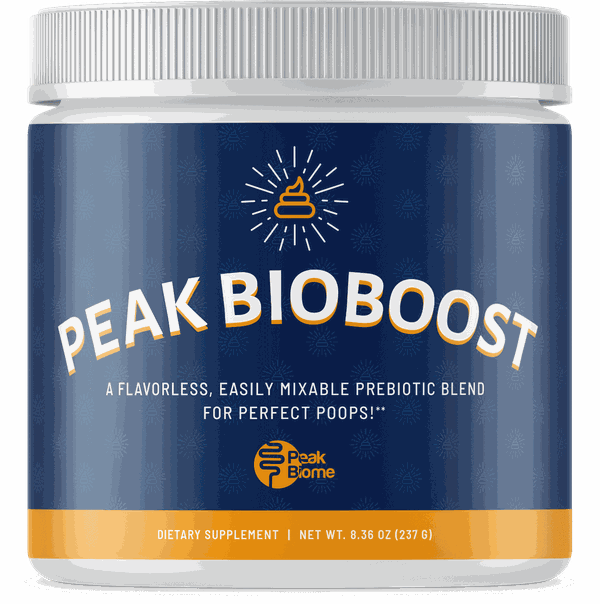
Peak BioBoost review: a real fiber dose, with fine print
A flavorless prebiotic fiber powder you stir into coffee or food. Unlike most gut supplements we check, a daily scoop holds an amount of fiber in the range used in studies. The refund policy is the weak spot.
Check Peak BioBoost price on the official siteThe short version
- What it is: a powder, one scoop (about 8.25 g) a day, 30 scoops per jar. Each scoop has 7 g of dietary fiber from an 8 g blend of inulin, FOS, acacia gum and XOS, plus 40 mg of magnesium. The label lists no probiotics, and the seller says it has no sweeteners, flavors or stimulants.
- Good:
- The label is published.
- 7 g of fiber a day is a real dose, in the range used in fiber trials, not a sprinkle hidden in a capsule.
- At $1.00 to $1.67 a day, it costs less than the other products we have checked, bundle for bundle.
- The seller says it is flavorless and dissolves in hot drinks.
- Concerns:
- XOS, which the sales page calls “the king of prebiotics”, is listed last, so a scoop holds at most 2 g of it.
- Inulin and FOS often cause gas and bloating, especially at first.
- Several headline numbers point to sources that don’t match the claim.
- The “100% money-back guarantee” covers only unopened jars.
What’s on the label
The Supplement Facts panel is shown as an image on the sales page. One serving is one scoop, about 8.25 g, and a jar holds 30.
| Label line | Per scoop |
|---|---|
| Calories | 30 |
| Total carbohydrate | 7 g (3% DV) |
| Dietary fiber | 7 g (25% DV) |
| Magnesium (as magnesium citrate) | 40 mg (10% DV) |
| Prebiotic blend: inulin (from Jerusalem artichoke), FOS (fructooligosaccharide), acacia gum, XOS (xylooligosaccharide) | 8 g, no amount for each fiber |
Labeling rules require blend ingredients to be listed from most to least by weight. So inulin is the largest fiber and XOS the smallest. With four ingredients sharing 8 g, the last one can weigh at most 2 g, and the first one at least 2 g.
The FAQ says the powder is free of sugar, artificial sweeteners, flavors, colors, preservatives, gluten, dairy and soy. It is made in a facility that also processes milk, eggs, wheat and soy. The sales page mentions a GMP-certified manufacturer and batch testing but doesn’t link to any lab results.
How the doses compare with the research
| Ingredient | In one scoop | In the research |
|---|---|---|
| Total fiber | 7 g | Psyllium studies typically use 7–10 g or more a day. The 2023 AGA–ACG guideline supports fiber supplements for chronic constipation. |
| Inulin | Not stated; the largest of the four, so at least 2 g | The EU’s approved health claim for chicory inulin and stool frequency is based on 12 g a day. A 2014 meta-analysis found that inulin improves stool frequency and consistency, but not pain or bloating. |
| XOS | Not stated; listed last, so at most 2 g | The constipation study the seller cites used 4.2 g a day. |
| Magnesium | 40 mg | Far below the amounts used for constipation: the AGA–ACG guideline starts at 400–500 mg of magnesium oxide a day. See magnesium for constipation. |
In short, the fiber total is meaningful, and inulin probably makes up most of it. The magnesium is too small to work as a laxative, and the XOS is below the dose the seller’s own reference used.
The psyllium attack, checked
The sales page calls most fiber supplements “quite frankly toxic” and lists the dangers of psyllium. Two of its points need context:
- Choking: psyllium swells, which is why its label says to take it with a full glass of liquid. That is a real precaution, not a reason to avoid it.
- Additives: citric acid, orange flavor and aspartame come from flavored brands. Plain psyllium husk is just psyllium.
Psyllium is the most studied fiber for constipation, and plain husk costs a few cents a day. See how much psyllium to take and what it really costs.
Marketing claims vs. evidence
We checked the numbers on the sales page against the references it lists at the bottom.
- “Increase stool frequency by 129%”: the page describes “one 6-week clinical study” of a prebiotic mixture. The reference it cites (number 17) is a 2014 meta-analysis of probiotic trials, not a prebiotic study.
- “Boost Lactobacilli by up to 344% and Bifidobacteria by up to 366%”: the cited reference (number 31) is a study in rats.
- “XOS relieves constipation with a 93% success rate”: this comes from a 2005 study of 30 constipated pregnant women. 27 of the 29 who finished could go without help after 4 weeks of 4.2 g of XOS a day. There was no placebo group, and Peak BioBoost has at most half that dose.
- “Poop out up to 10 pounds of bloat” and weight-loss stories: we found no study of the product behind them. The site’s own disclaimer says testimonials “may not reflect the typical purchaser’s experience”.
- Professional endorsement: the one expert quoted is a licensed naturopathic physician, not a gastroenterologist.
Price per jar and per day
At one scoop a day, a jar lasts 30 days. Checkout is handled by the retailer Digistore24, and sales tax is added for some US states.
- 1 jar: $49.95, or $1.67 a day.
- 3 jars: $119.85 ($39.95 each), or $1.33 a day.
- 6 jars: $179.70 ($29.95 each), or $1.00 a day, with free US shipping.
- Shipping: 1 and 3 jars add $6.95 US shipping. That is what the checkout charged on October 18, 2026; the sales page says $9.95.
- Two scoops: the seller suggests going up to two scoops a day if one isn’t enough, which doubles the cost per day.
- Subscribe & Save: $44.95 every 30 days with free US shipping, cancel any time. For subscriptions, the refund policy covers only the most recent payment, case by case.
30-day supply
+$6.95 US shipping
90-day supply
+$6.95 US shipping
180-day supply
Free US shipping
The refund policy, in plain English
- The sales page promises a “3-Month 100% Money-Back Guarantee” and, further down, a “6-month, 100% money-back guarantee”.
- The shipping policy settles on 6 months, but adds: “Do not send back anything that’s already been opened.” The refund policy also asks for “all unopened bottles”.
- You pay the return shipping. The policy says the refund is generally full, minus return shipping and handling charges. Returns go to Jetpack Shipping in Tallmadge, Ohio.
- In practice, the jar you try is not refundable. If you buy 6 and it doesn’t suit you, you can return the unopened ones within the guarantee period. Starting with one jar costs more per day but risks less.
Who should be careful
- The seller’s own warning is broad: do not take it if you are pregnant, nursing, under 18, taking prescription or over-the-counter medication, or have or suspect a medical condition, without asking a doctor. That covers many of the older adults the page is aimed at.
- People with IBS or a sensitive gut: inulin and FOS are fructans, one of the FODMAP groups that commonly trigger gas and bloating. If you follow a low-FODMAP diet, this blend works against it.
- Food allergies: it is made in a facility that also processes milk, eggs, wheat and soy.
- Anyone with warning signs such as blood in the stool, unexplained weight loss or persistent pain. See our guide for the signs that need a doctor first.
How it compares with the capsules we checked
The other products on this site put 500 mg to 1.5 g of blend into a day’s serving. Peak BioBoost gives 7 g of fiber and costs less per day than any of them, bundle for bundle. That makes it the most substantial label we have checked so far. The same amount of fiber is also available as plain inulin or psyllium for much less. What you pay extra for is the mix of four fibers and a powder that disappears in coffee. See all the products side by side in our comparison.
Questions people ask about Peak BioBoost
Is Peak BioBoost legit?
It is a real product from Peak Biome LLC with a published Supplement Facts label, and orders are processed by the retailer Digistore24. Unlike many gut supplements, a daily scoop contains a meaningful amount of fiber, 7 g. The weak spots are the marketing claims and a refund policy that accepts only unopened jars.
Does Peak BioBoost work?
We found no study of Peak BioBoost itself. Inulin, its main fiber, has trials showing more frequent and softer stools, and 7 g of fiber a day is in the range used in fiber studies. XOS can be at most 2 g per scoop, under half the dose in the study the seller cites.
What are the side effects?
Gas, bloating and cramping are the most common side effects of inulin and FOS, especially in the first weeks or in people with IBS. The seller says to ask a doctor first if you are pregnant, nursing, under 18, take any medication or have a medical condition.
Can I get a refund?
Only for unopened jars, and you pay the return postage. The shipping policy gives 6 months; one line of the sales page says 3.
How much does it cost?
$49.95 for one jar, $119.85 for three and $179.70 for six on the official site, or $1.67 to $1.00 a day at one scoop. One and three jars add $6.95 US shipping; six ship free. If you see it sold elsewhere, compare the label and refund terms with the official site.
Sources
- Peak BioBoost official site (mypeakbiome.com): sales page with Supplement Facts image, FAQ and reference list, Refund Policy and Shipping Policy; Digistore24 checkout pages for 1, 3 and 6 jars. Checked October 18, 2026.
- Chang L. et al. AGA–ACG Clinical Practice Guideline: Pharmacological Management of Chronic Idiopathic Constipation, 2023. PMC10542656
- Collado Yurrita L. et al. Effectiveness of inulin intake on indicators of chronic constipation: a meta-analysis of controlled randomized clinical trials. Nutrición Hospitalaria, 2014. DOAJ
- EFSA Panel on Dietetic Products, Nutrition and Allergies. Scientific Opinion on the substantiation of a health claim related to “native chicory inulin” and maintenance of normal defecation by increasing stool frequency. EFSA Journal, 2015;13(1):3951.
- Tateyama I. et al. Effect of xylooligosaccharide intake on severe constipation in pregnant women. J Nutr Sci Vitaminol, 2005;51(6):445–448.
- Dimidi E. et al. The effect of probiotics on functional constipation in adults: a systematic review and meta-analysis of randomized controlled trials. Am J Clin Nutr, 2014;100(4):1075–1084 (reference 17 on the sales page).
- U.S. Code of Federal Regulations, 21 CFR 101.36: proprietary blends listed in descending order of predominance by weight. ecfr.gov