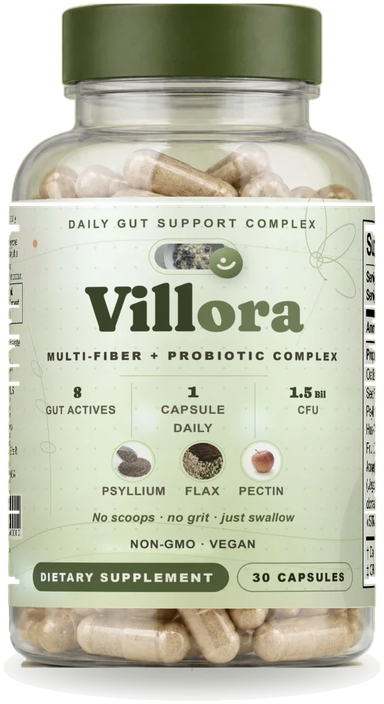
Villora review: what one capsule can really hold
A one-a-day fiber and probiotic capsule with a full ingredient list, a 695 mg total dose and a label that leaves the probiotic strain blank.
Check Villora price on the official siteWhat’s actually on the label
The sales page shows the full Supplement Facts panel. One serving is 1 capsule, and each bottle holds 30. All active ingredients sit in one 695 mg proprietary blend, so the label lists them in order of weight but doesn’t say how much of each you get.
That order still tells you something. The third ingredient can’t weigh more than a third of the blend, the fifth no more than a fifth, and so on. That gives a ceiling for every ingredient:
| Ingredient (label order) | Most it can be per capsule | What we can say |
|---|---|---|
| Oat bran powder | 695 mg (the largest share) | A food fiber. A bowl of oat bran is tens of grams. |
| Flax seed powder | 347 mg | Ground flaxseed. One tablespoon weighs about 7 g. |
| Psyllium husk powder | 232 mg | The best-studied fiber for constipation. The review the seller cites found that more than 10 g a day worked best. |
| Apple pectin powder | 174 mg | A soluble fiber. |
| Konjac root powder (glucomannan) | 139 mg | Swells in water, which is why the label carries a choking notice. The konjac study the seller cites gave 4.5 g a day. |
| Black walnut hull powder | 116 mg | Sold as the “cleanse” ingredient. None of the seller’s 32 references studies it. It is the reason the label says “Contains tree nuts”. |
| Plum powder | 99 mg | The prune study the seller cites used 50 g of prunes twice a day, about a thousand times more. |
| Lactobacillus acidophilus «STRAIN ID» | 1.5 billion CFU, counted at manufacture | The strain name is missing (see below). The two strains in the seller’s references were tested at 10 billion and 200 billion CFU a day. |
The label image looks unfinished
Where the probiotic strain should be named, the label on the sales page prints the placeholder «STRAIN ID». The barcode is all zeros and the lot number reads “EGSB_000_01_MMDDYY”. That looks like a design file rather than the label on a shipped bottle. If you order, check that your bottle names the strain. Probiotic effects depend on the exact strain, and without the name it can’t be matched to any study.
How much fiber is that, really?
The whole capsule weighs 695 mg, and not all of it is fiber: oat bran and flax are only partly fiber, and the blend also holds walnut hull, plum and the probiotic. So one capsule gives you well under 0.7 g of fiber a day.
For scale, the U.S. Dietary Guidelines suggest about 14 g of fiber per 1,000 calories, roughly 28 g on a 2,000-calorie diet. A level tablespoon of plain psyllium powder holds 7 g. To get the 10 g of psyllium a day that worked best in the seller’s own cited review, you would need more than 40 Villora capsules a day, and the label says not to take more than one.
Villora vs GutOptim: the same recipe at half the dose
All eight Villora ingredients are also in GutOptim, which we reviewed in October. GutOptim adds bentonite clay and aloe vera leaf. The price per bottle is the same.
| Villora | GutOptim | |
|---|---|---|
| Daily serving | 1 capsule | 2 capsules |
| Blend per day | 695 mg | 1.5 g |
| First ingredient | Oat bran | Psyllium husk |
| Extra ingredients | None | Bentonite clay, aloe vera leaf |
| Probiotic on the label | L. acidophilus «STRAIN ID», 1.5 billion CFU at manufacture | L. acidophilus, no strain or CFU |
| Capsule | Vegetable (vegan) | Gelatin |
| Price per bottle | $69 (2), $59 (4), $49 (6) | $69 (1), $59 (3), $49 (6) |
| Smallest order | 2 bottles, $138 + $9.99 shipping | 1 bottle, $69 |
| Cost per day | $2.47 to $1.63 | $2.30 to $1.63 |
| Price per gram of blend | $3.55 to $2.35 | $1.53 to $1.09 |
| Refund window | 60 days from purchase | 60 days from delivery |
| Returns go to | Aurora, CO | Aurora, CO |
Price per bottle and per day
Each bottle lasts 30 days. The smallest order is 2 bottles. Counting its $9.99 shipping, that is $2.47 a day; 4 bottles cost $1.97 a day and 6 bottles $1.63, both with free US shipping. The site calls these “launch prices” against a “regular price” of $99 a bottle. The 4- and 6-bottle orders add two digital guides: one on picking sushi at an all-you-can-eat buffet, and one called “Eating Well, Living Better”. Villora ships to the USA only.
60-day supply
+$9.99 shipping
120-day supply
Free US shipping
180-day supply
Free US shipping
The refund policy, in plain English
- You have 60 days from the purchase date, the date on your order confirmation email. Delivery takes 3–5 days of that.
- Send back all bottles, opened, unopened or empty. That is better than policies that accept only sealed bottles.
- First contact BuyGoods (lookup.buygoods.com) for a return authorization number. The policy says a package without one can’t be refunded. The product page’s FAQ says just to email the seller, so follow the Returns page.
- You pay the return shipping, and the original $9.99 shipping on a 2-bottle order isn’t refunded. Returns go to a warehouse in Aurora, Colorado, not to the company’s Albuquerque office.
- The guarantee applies once per customer and household, and refunds are “at our sole discretion”. Upsell bottles are covered on the same terms. There is no subscription.
The catch is the same as with GutOptim. The seller says regular bowel habits may change in the first weeks, while the “lighter belly” builds “over the following months”, and it calls the 6-bottle order “the complete Sweep, Cleanse, Repair cycle”. The refund window closes after 60 days. If you try it, decide by about day 50 after ordering.
Marketing claims vs. evidence
Most sales traffic lands first on an article-style page, “Why Your Fiber Powder Might Be Leaving You More Bloated, and 5 Other Gut Myths”. The page does say it is an advertisement and that Carol, the 58-year-old in its story, is a dramatization performed by actors. Here is how its main points hold up:
- “Psyllium works differently”: true. The page correctly cites research that psyllium forms a gel and is barely fermented, so it causes less gas than many fibers. But in Villora psyllium is the third ingredient, at most 0.23 g a capsule.
- “Prunes are just an old wives’ tale” (a myth, the page says): the cited trial is real. Its prune group ate 50 g of prunes twice a day. Villora’s plum powder is at most 99 mg.
- “Sweep, Cleanse, Repair”: the product page gives each ingredient a “job”, with black walnut hull creating “a clean internal environment where unwelcome things don’t feel at home”. No study supports this for Villora. The seller itself says its references “are not studies of the finished product”.
- The parasite hint: the story ends on what Carol had been eating “every Friday night for six years”. 13 of the 32 references are about tapeworms and Anisakis worms from raw or undercooked fish, and a bonus guide is about sushi buffets. Those infections are real, and the CDC’s advice is to see a doctor: fish tapeworm is treated with medicine, and an Anisakis worm is removed by endoscopy or surgery. Nothing in the references shows that black walnut hull treats them. More in our article on parasite cleanses.
- “Bought separately, these eight are seven bottles and over $200 a month”: the footnote says it is an estimate based on a psyllium blend, a black walnut hull tincture and a probiotic bought separately. Plain psyllium powder costs a few cents a gram.
Five of the references are about constipation on GLP-1 weight-loss drugs such as semaglutide and tirzepatide, and the seller runs a version of the sales page aimed at people taking them. That page says Villora hasn’t been studied in people on these medicines. If you take one and get constipated, tell the doctor who prescribes it.
Who might consider it, and who should skip it
It may suit you if you want a small, one-a-day capsule, are fine paying for convenience and don’t expect it to replace a real fiber dose. Use the refund window if it doesn’t help.
Talk to a doctor first, or skip it, in these cases:
- You are pregnant or nursing, or under 18.
- You have a tree nut allergy or trouble swallowing.
- You take prescription medication, including GLP-1 drugs. Fiber can affect how some medicines are absorbed, so they are usually taken a couple of hours apart.
- You have warning signs such as blood in the stool, unexplained weight loss, persistent pain or a new change in bowel habits after 45. Our guide lists the signs that need a doctor first.
A simpler alternative worth knowing
If constipation is the main problem, the best-supported over-the-counter option is plain psyllium husk at the dose used in studies. Powder costs a few cents per gram of fiber. If you prefer pills, store-brand psyllium capsules hold about 0.52 g each, so a label dose of 5 capsules gives more psyllium than ten Villora capsules could. We compare the options in fiber pills vs powder.
Questions people ask about Villora
Is Villora legit?
It is a real product from Gold Angels Agency LLC, sold through the retailer BuyGoods, with a published label and a written 60-day refund policy. Whether it is worth the price is another question: the psyllium in a capsule can be at most about 0.23 g, while the review the seller cites found more than 10 g a day worked best.
What are the side effects?
The label warns that eating it without at least a full glass of liquid may cause choking, and it contains tree nuts (walnut). Fiber can cause gas and bloating at first and can affect how some medicines are absorbed.
What are the ingredients?
A 695 mg blend of oat bran, flax seed, psyllium husk, apple pectin, konjac root, black walnut hull and plum, plus Lactobacillus acidophilus at 1.5 billion CFU at the time of manufacture. See the ingredient-by-ingredient breakdown above.
Is Villora the same as GutOptim?
No, but all eight Villora ingredients are also in GutOptim, which adds bentonite clay and aloe. GutOptim gives 1.5 g of blend a day in 2 capsules, Villora 695 mg in one, at the same price per bottle.
Where can I buy Villora?
On its official website, with checkout by BuyGoods: $69 a bottle for 2 bottles plus $9.99 shipping, $59 for 4 and $49 for 6, with free US shipping on 4 and 6. It ships to the USA only.
How long does it take to work?
There is no study of Villora itself, so there is no evidence-based timeline. The seller says benefits build over months, but the refund window is 60 days from the purchase date.
Sources
- Villora official site (tryvillora.com): Supplement Facts label image, product page with prices and FAQ, the advertorial page and its 32 references, and the Returns & Refunds policy (effective September 16, 2026). Checked November 20, 2026.
- van der Schoot A. et al. The effect of fiber supplementation on chronic constipation in adults: an updated systematic review and meta-analysis of randomized controlled trials. Am J Clin Nutr, 2022. PMC9535527
- McRorie JW Jr, McKeown NM. Understanding the Physics of Functional Fibers in the Gastrointestinal Tract. J Acad Nutr Diet, 2017. PubMed 27863994
- Attaluri A. et al. Randomised clinical trial: dried plums (prunes) vs. psyllium for constipation. Aliment Pharmacol Ther, 2011. PubMed 21323688
- Chen HL et al. Supplementation of konjac glucomannan into a low-fiber Chinese diet promoted bowel movement and improved colonic ecology in constipated adults. J Am Coll Nutr, 2008. PubMed 18460488
- Ringel-Kulka T. et al. Probiotic bacteria Lactobacillus acidophilus NCFM and Bifidobacterium lactis Bi-07 versus placebo for the symptoms of bloating in patients with functional bowel disorders. J Clin Gastroenterol, 2011. PubMed 21436726
- Martoni CJ et al. Lactobacillus acidophilus DDS-1 and Bifidobacterium lactis UABla-12 Improve Abdominal Pain Severity and Symptomology in Irritable Bowel Syndrome: Randomized Controlled Trial. Nutrients, 2020. PubMed 32019158
- CDC. About Diphyllobothrium (fish tapeworm) and About Anisakiasis: treatment and recovery. cdc.gov, cdc.gov
- U.S. Department of Agriculture and HHS. Dietary Guidelines for Americans, 2020–2025. dietaryguidelines.gov
- Chang L. et al. AGA–ACG Clinical Practice Guideline: Pharmacological Management of Chronic Idiopathic Constipation, 2023. PMC10542656